



By Desiree Stock, 479-409-4241
Executive Broker, Collier & Associates
November 12, 2026 edition
You may have been casually browsing listings when a home caught your attention. It has the layout you need, the location you want, or the outdoor space you have been missing. Suddenly, a move that felt months away becomes something you are seriously considering. One complication remains: you still own your current home, and you may need to sell it before you can buy another.
Buying and selling at the same time requires more than finding a buyer and choosing two closing dates. Your financing, available cash, contract terms, and moving arrangements all need to work together. The right approach depends on what you need from your current home’s sale and how much uncertainty you can comfortably manage.
First, Understand What Depends on Your Sale
Before making an offer, determine whether you need to sell your current home to qualify for the next mortgage, access money for the purchase, or both. These are different challenges. A homeowner might qualify to carry both mortgages but need the sale proceeds for a down payment. Another might have enough savings for the purchase but be unable to qualify while the existing mortgage remains part of their monthly obligations.
That distinction matters because a preapproval based on selling your home first may not support purchasing before the sale closes. Fannie Mae’s guidelines, for example, generally require counting both housing payments when a current residence is pending sale and will close after the new purchase. An exception is available with an executed sales contract and confirmation that any financing contingencies have cleared. Your lender will need to determine which requirements apply to your loan and what documentation is necessary. [1]
Ask your lender to explain your purchasing options under both scenarios: buying after your home sells and buying while you still own it. This gives you a clear starting point before you negotiate a purchase that depends on financing or funds you may not yet have available.
Making an Offer That Depends on Selling Your Home
One approach is to make your purchase contingent on selling your current property. The National Association of REALTORS® distinguishes between a home-sale contingency, which gives you time to sell an existing home, and a home-close contingency, which addresses completing a sale already under contract. The protection each provides depends on the language and deadlines the parties agree to. [2]
For the seller considering your offer, the question becomes how likely your sale is to happen within the proposed timeline. A home that still needs repairs, photography, and several weeks of preparation presents a different situation from one that is already under contract and progressing toward closing. Preparing your home before pursuing the next one can help you present a more credible plan, even if your purchase still depends on the sale.
The contract should also address what happens if that plan changes. Have your agent explain the deadline for meeting the contingency, any required notices, and your rights and obligations if your home does not sell or close on time. Understand how any deposit will be handled under those circumstances rather than assuming that a contingency automatically resolves every financial concern.
A seller may also negotiate the right to continue marketing the property. A provision often called a “kick-out clause” can set out a process for responding to another acceptable offer, potentially requiring you to show you can proceed without the sale contingency. The details vary by agreement, so understand the trigger, response period, and requirements before signing. Remove that protection only after you confirm you can complete the purchase even if your existing home does not sell. [2]
Buying First Can Simplify the Move but Adds Financial Exposure
If your finances allow it, purchasing before selling can provide breathing room. You may be able to move gradually, prepare your former home after moving out, and avoid arranging temporary housing. That convenience comes with the responsibility of carrying both properties until the sale is complete, potentially for longer than you anticipated.
Depending on lender approval and your circumstances, funding options may include savings, a bridge loan, or borrowing against existing home equity. Bridge financing can help cover the gap between buying and selling, while borrowing against home equity creates another obligation secured by your property. Availability, costs, eligibility, and repayment terms vary, making it important to review the full arrangement rather than focusing only on whether it provides the down payment. [3]
The most useful way to evaluate buying first is to test it against a slower sale. Consider what your finances would look like if you carried both homes for several months, accepted less than your target price, or had a buyer terminate after inspection. Mortgage payments are only part of the overlap; utilities, insurance, maintenance, and additional financing costs must also fit within your budget. If your former home will be vacant, ask your insurance professional whether your coverage needs to change.
A lender’s approval establishes what you qualify to borrow. Your budget should reflect what you can carry comfortably while maintaining reserves for repairs, moving expenses, and everyday life.
Selling First Offers Certainty, With Some Logistical Tradeoffs
Selling before buying can give you a clearer financial position. Once the sale is complete, you know the proceeds available for your next purchase and no longer have to manage the former home’s ownership costs. The challenge is deciding where you will live while you search for and close on the next property.
Temporary housing, storage, and a second move may be necessary. In some transactions, a buyer may agree to let the seller remain in the home briefly after closing through a written occupancy or rent-back arrangement. The agreement should address the length of the stay, compensation, and move-out date, with additional attention to responsibilities, insurance, and applicable lender requirements. [2]
Although an interim move can feel inconvenient, it may give you more flexibility when choosing your next home. You can evaluate properties with a known budget and fewer dependencies, rather than feeling pressure to make a purchase work because your own closing is approaching. Whether that flexibility outweighs the disruption depends on your household, schedule, and available housing options.
Build Your Budget Around What You Will Actually Receive
When planning the next purchase, it is easy to focus on your current home’s expected sale price. What matters for your down payment, however, is what remains after your mortgage payoff and transaction expenses. Ask for an estimated seller net sheet that reflects anticipated costs, including any concessions or repairs you are considering.
Reviewing more than one outcome can make that estimate more useful. Look at your target price, a lower sale price, and a longer selling period, then consider how each would affect the purchase. If a modest change in proceeds would leave you short of the funds needed to close, address that before committing to the next home.
For Northwest Arkansas homeowners, this planning should reflect the property itself, its location, condition, competing listings, and preparation needs. A broad impression that homes in the area sell quickly cannot tell you when your particular home will close or how much you will have available afterward.
Coordinate the Money, the Closings, and the Move
Two closings scheduled for the same day can look efficient on a calendar, but the transactions still need to happen in the correct sequence. Your agent, lender, and title company should confirm when sale proceeds will be available, what documentation the purchase requires, and when possession transfers at each property. Ask whether a buffer between closings would make the plan more manageable and what would happen if either transaction were delayed.
Moving arrangements deserve the same attention. Before reserving movers or committing to a delivery date, understand when you must leave your current home and when you can enter the next one. Having an alternative for a short gap — whether that means temporary lodging, storage, or another agreed arrangement—can keep a closing delay from becoming a much larger disruption.
Finding a home you want to buy before selling your current one does not necessarily mean you have to let it go. It means you need to understand which parts of the purchase depend on the sale and choose an approach that fits your finances and tolerance for uncertainty. With realistic expectations, carefully reviewed terms, and a workable backup plan, you can pursue the next home with a clearer understanding of both the opportunity and the commitment.
Sources
[1] Fannie Mae: Qualifying Impact of Other Real Estate Owned
[2] National Association of REALTORS®: Consumer Guide to Real Estate Sales Contract Contingencies
[3] Citizens: Selling Your Home and Buying Another

Featured Listing of the Week
🏡 5 W Mt. Nord Street, Fayetteville, AR 72701

💰 $2,200,000 · 4 Bedrooms · 3 Full / 1 Half Bathrooms · 5,108 Sq Ft · 0.71 Acres · Built in 1896
Some homes are a part of a city's story. 5 W Mt. Nord is one of them. Set in Fayetteville's historic Mt. Nord neighborhood, this remarkable residence carries a meaningful connection to the Fulbright family and the University of Arkansas. Recognized on the National Register of Historic Places, the home offers approximately 5,100 square feet and a presence that feels distinctly its own. Significant plumbing and electrical improvements bring modern functionality to a property rich with history and character. A separate, temperature-controlled detached space of approximately 500 square feet, including a half bath, add flexibility; it is not including in the home's reported square footage. Near the University of Arkansas and the heart of Fayetteville, 5 W Mt. Nord is more than a distinguished address - it is a chance to become the next steward of a home with a lasting place in Fayetteville history.
🤝 Listed by: Josie White
📞 (479) 601-4972
🏢 Collier & Associates
📞 Office: (479) 274-0662
MLS #: 1364827
Most Expensive Sales of the Week
November 1–7, 2026 · Residential closed sales
Benton County
🏡 6805 S 65th Street, Cave Springs, AR 72718
💰 Sales Price: $1,818,624
📅 Sold Date: 11/02/2026
MLS #: 1308569
🤝 Represented by:
Seller’s Agent: Jodi Waters | Jia Communities Realty LLC
📞 Direct: (479) 957-5779 | Office: (479) 957-5779
Buyer’s Agent: Jodi Waters | Jia Communities Realty LLC
📞 Direct: (479) 957-5779 | Office: (479) 957-5779
Co-selling Agent: Ophelia Chen | Jia Communities Realty LLC
📞 Direct: (417) 512-8782 | Office: (479) 957-5779
Washington County
🏡 2607 Riverfront Lane, Fayetteville, AR 72703
💰 Sales Price: $2,000,000
📅 Sold Date: 11/02/2026
MLS #: 1361399
🤝 Represented by:
Seller’s Agent: Melanie Gabel | Gabel Realty
📞 Direct: (479) 422-4221 | Office: (479) 485-0695
Buyer’s Agent: Danielle Jurado | Keyrenter Arkansas
📞 Direct: (831) 332-6634 | Office: (479) 662-1800
NWA Real Estate Market Update
November 1–7, 2025 vs. November 1–7, 2026 · Benton and Washington counties combined
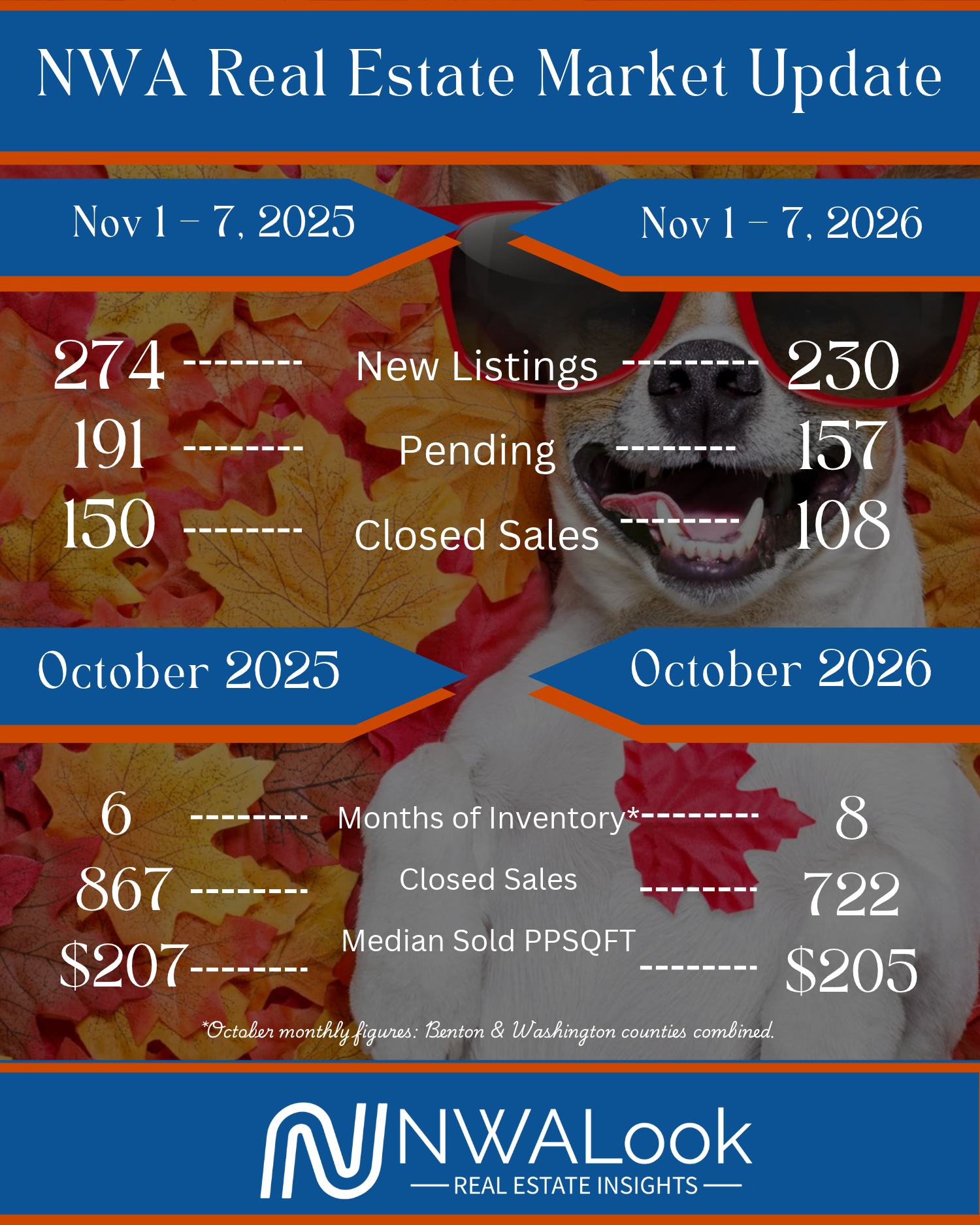
Weekly Activity: Percentage Change
| Activity | Year-over-year change |
|---|---|
| New listings | −16.1% |
| Pending listings | −17.8% |
| Closed sales | −28.0% |
Northwest Arkansas Weekly Rundown
November 1–7, 2026 · Residential closed sales
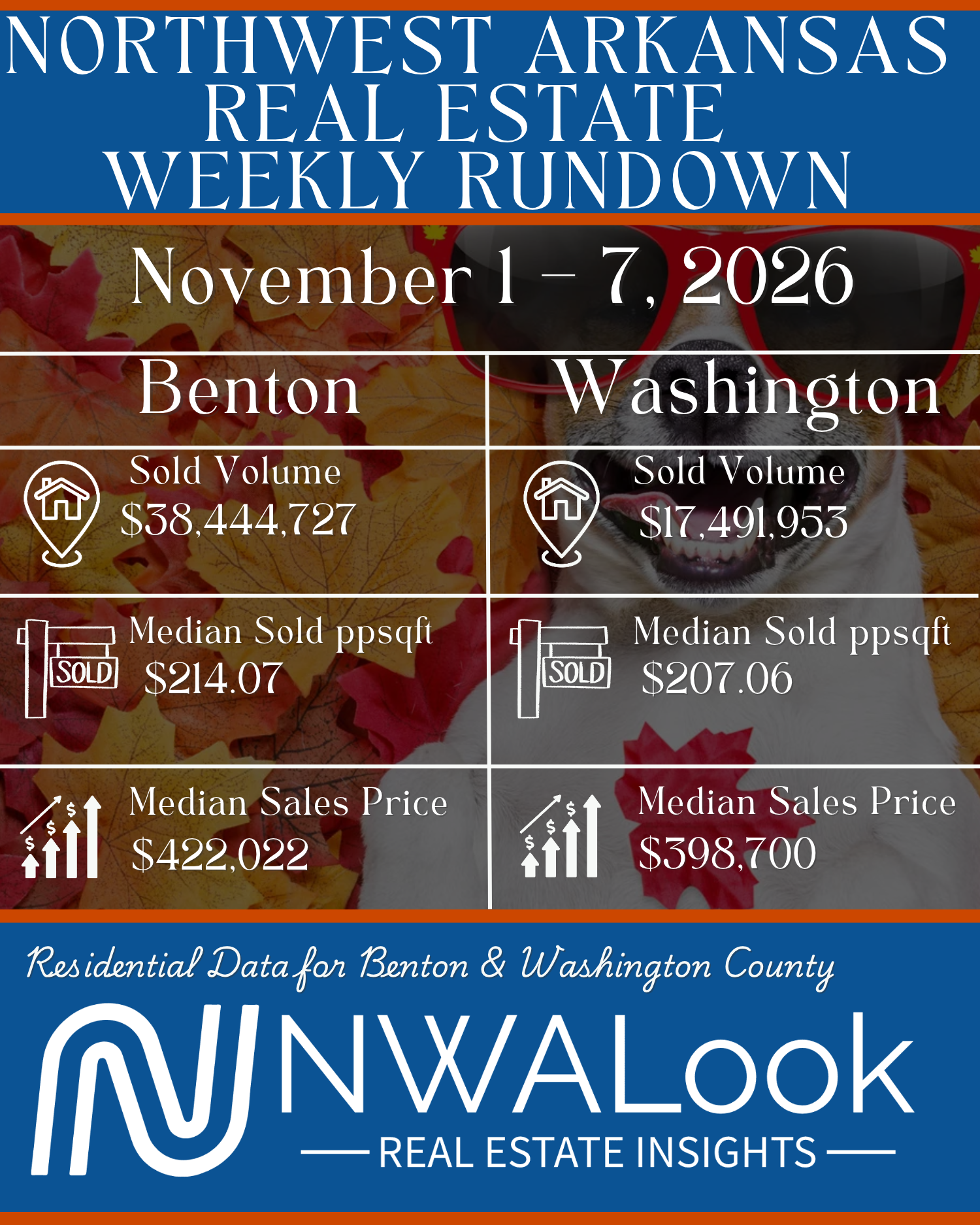
Benton County recorded 72 closed sales; Washington County recorded 36.
Mortgage Market Update
Leadership Tip of the Week: Make It Easier to Raise a Concern
Small problems are easier to address when people feel comfortable bringing them up early. But a leader’s first reaction can determine whether the next concern gets shared at all.
If someone points out a mistake, a confusing process, or a promise the team may struggle to keep, pause before defending the decision. Ask what they are seeing and what the consequences could be.
You do not have to agree with every concern. You do need to make it possible to discuss one without the person regretting speaking up.
For example, if a teammate says a deadline is unrealistic, ask which part of the work is at risk. You may need to adjust the scope, add support, or explain why the deadline matters. Either way, the conversation gives you information you would otherwise miss.
Leadership Tip: This week, ask your team, “What is one issue we should address before it becomes a bigger problem?” Listen, then follow up on what you learn.
— Desiree
NWA Planning Meetings by City
Development decisions start long before the construction equipment arrives. Follow the planning conversations happening in your community.
View NWALook's planning meeting guide. Confirm current meeting dates, agendas, and locations with the city before attending.
Support Local. Reach Local.
Have a business, service, or event you'd like Northwest Arkansas readers to know about? For NWALook advertising opportunities, email Crew@NWALook.com.
Stay Connected With NWALook
Know someone who would find this week's article useful? Forward this edition and invite them to subscribe at NWALook.com.
Follow NWALook on Instagram and Facebook.

This newsletter provides general information and does not replace property-specific real estate, lending, legal, or investment advice. Verify property details and financing terms with the appropriate professionals. This newsletter is not intended to solicit or interfere with clients represented by another real estate professional. Equal Housing Opportunity.


